Acoustics 101: Understanding How Sound Works — and How Noise Walls Make a Difference
Sound is part of everyday life — from transportation corridors and industrial facilities to commercial developments and public infrastructure. But before we talk about controlling noise, it helps to understand what sound actually is and how it behaves.
At RMP Global, effective acoustic wall design starts with understanding the science.
What Is Sound?
Sound travels as pressure waves — small, rapid fluctuations in air pressure that radiate outward from a source. These waves follow patterns that correspond to the type of sound being produced.
Two foundational characteristics define most sounds:
Amplitude (Loudness)
Amplitude refers to the strength of the pressure fluctuation. In simple terms, it relates to how loud a sound feels. Loudness is typically measured in decibels (dB). Higher amplitude means greater sound energy.
Frequency (Pitch)
Frequency is the number of wave cycles that occur each second and is measured in Hertz (Hz). It corresponds to what we perceive as pitch.
- Low frequency = deeper, rumbling sounds
- Mid frequency = speech and most transportation noise
- High frequency = sharper, more piercing sounds
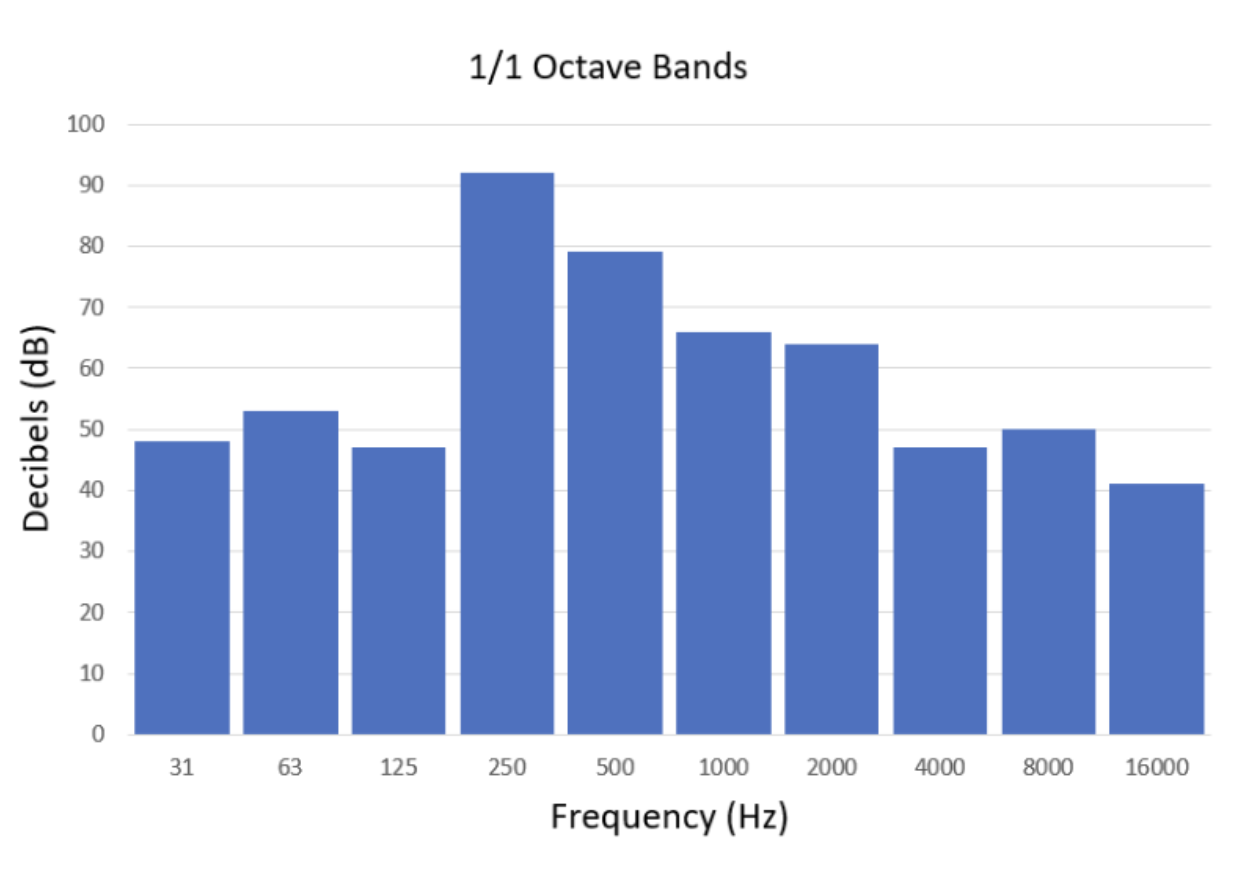
Most real-world noise isn’t a single tone. Traffic noise, for example, includes engine and tire noise, aerodynamic effects, and intermittent braking or acceleration — all blending across multiple frequencies.
Understanding that mix matters, because different frequencies behave differently when they encounter buildings, terrain, and barriers.
Why Frequency Matters in Noise Control
Frequency strongly influences how sound travels and how people experience it.
- Low-frequency sounds (like diesel engines or heavy equipment) have long wavelengths. They can travel farther and are more likely to bend over obstacles.
- Mid-frequency sounds include much of human speech and many transportation components.
- High-frequency sounds (alarms, squeals, impacts) are more directional and often easier to block.
Humans typically hear from about 20 Hz to 20,000 Hz, but we are not equally sensitive across that range. This is why environmental noise is often measured using A-weighted decibels (dBA), which better reflect how people actually perceive sound.
From a barrier design standpoint, this matters greatly:
- Low frequencies can diffract (bend) over walls more easily.
- High frequencies are more effectively reduced through line-of-sight blocking.
Effective noise wall systems account for these realities by combining proper height, length, placement, and material performance to address the most relevant frequencies for the project.
The Source–Path–Receiver Model
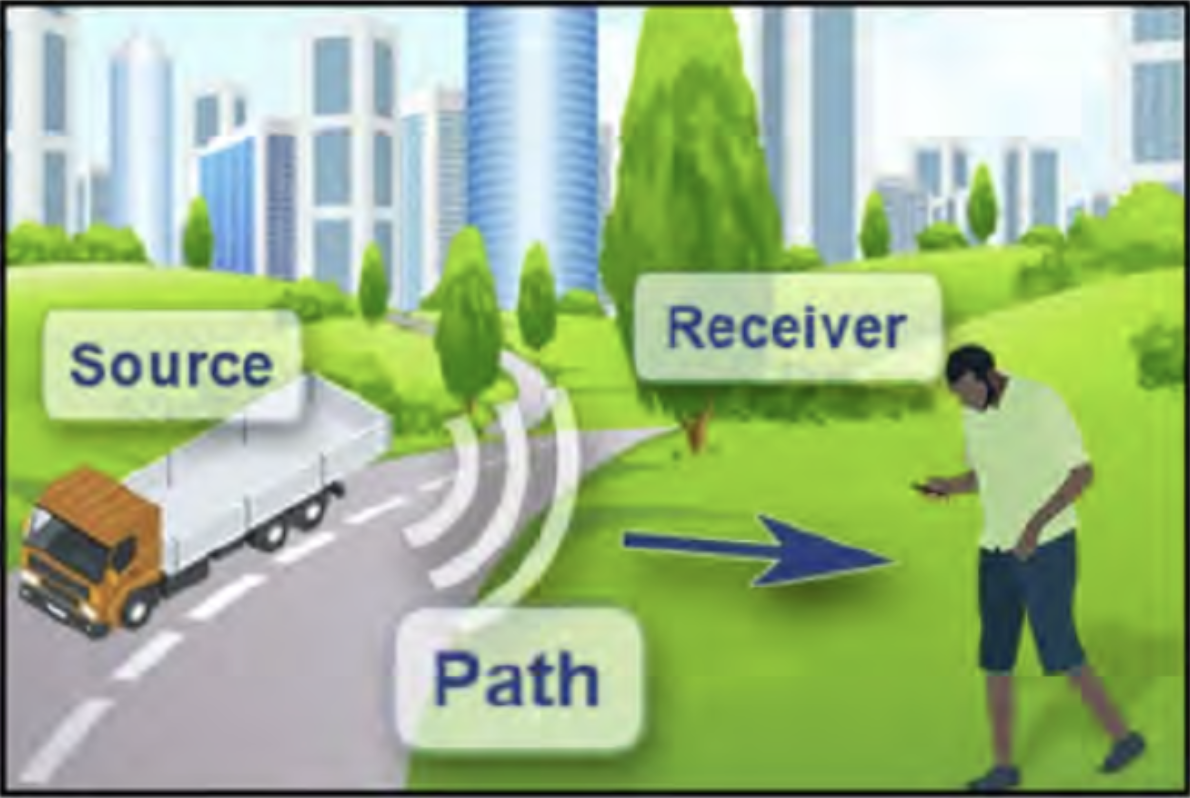
A simple way to think about environmental noise is through the Source–Path–Receiver model.
Source
The origin of the noise:
- Vehicles
- Rail
- Aircraft
- HVAC systems
- Loading docks
- Industrial equipment
Path
How the sound travels:
- Through open air
- Around buildings
- Across terrain
- Over or around barriers
Receiver
The person or place affected:
- Homes
- Schools
- Hospitals
- Offices
- Public spaces
Noise control strategies typically address one or more parts of this chain.
- Some projects reduce noise at the source (quieter equipment or operational limits).
- Others protect the receiver (building upgrades or setbacks).
- Noise walls focus on the path, reducing how much sound energy reaches sensitive areas.
Path control is often the most practical solution because it can reduce community impact without restricting operations.
How Noise Barriers Work
Noise walls reduce sound primarily in two ways:
1. Blocking Direct Sound
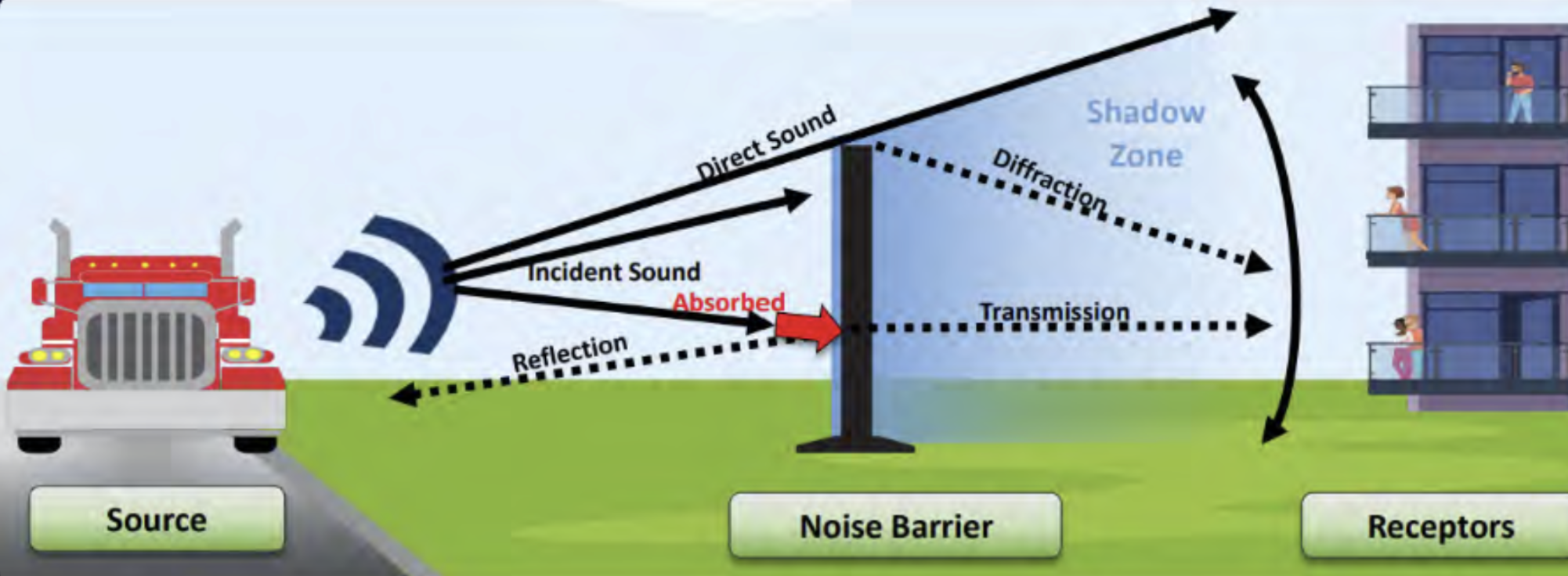
When a barrier interrupts the line of sight between the source and receiver, it creates an acoustical shadow zone. In that zone, the receiver is shielded from direct sound energy traveling in a straight line.
However, sound rarely behaves perfectly.
- Diffraction – Sound bends over the top of the wall.
- Flanking – Sound wraps around the ends.
- Transmission – Sound passes through the wall material if it isn’t sufficiently dense.
This is why barrier height, length, material mass, and placement are critical.
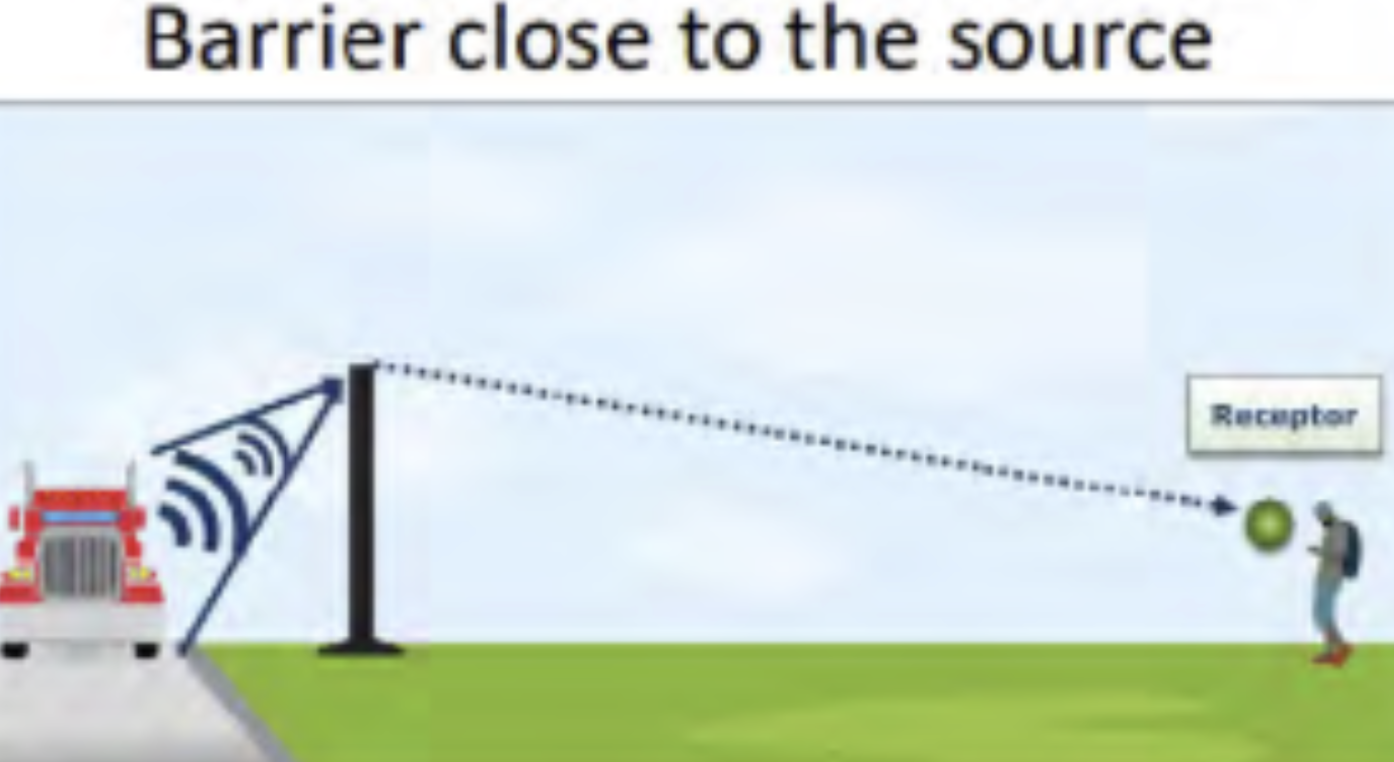
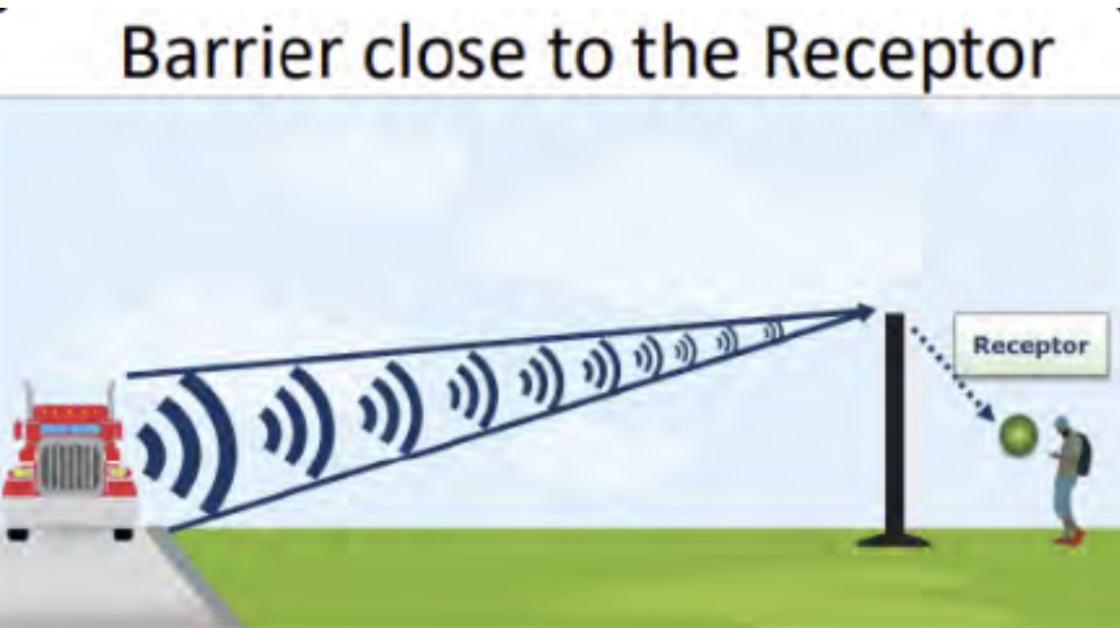
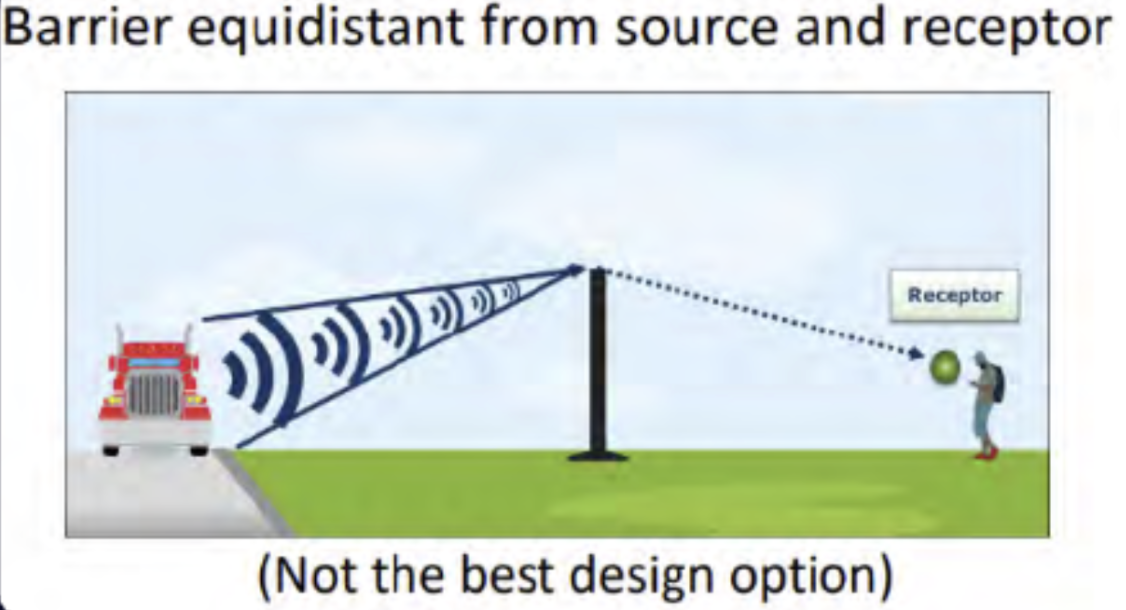
A wall that is too short or ends too early allows sound to “leak” around it, reducing performance. Strategic placement — typically closer to the source or receiver — maximizes the size and effectiveness of the shadow zone.
2. Managing Sound Energy
Beyond blocking, walls also manage reflected sound energy. In transportation or industrial corridors, reflected sound can bounce back toward traffic lanes, structures, or nearby receptors.
Proper material selection helps control this effect.
Key Acoustic Performance Metrics
Two common metrics describe how a noise wall performs:
STC (Sound Transmission Class)
STC measures how well a wall blocks airborne sound from passing through it.
Higher STC = Less sound transmission
This ensures the wall functions as a true barrier rather than a “leaky” partition.
NRC (Noise Reduction Coefficient)
NRC measures how much sound a surface absorbs rather than reflects.
Higher NRC = Less reflected sound energy
A helpful way to remember:
- STC = Blocking sound through the wall
- NRC = Absorbing sound at the surface
In many real-world applications, optimal performance combines both — limiting transmission while managing reflections on the source side.
Designing for Real-World Performance
Effective acoustic wall systems are not one-size-fits-all. They require:
- Appropriate height and length geometry
- Strategic placement relative to source and receiver
- Materials with sufficient mass and performance ratings
- Consideration of frequency content
- Long-term durability in outdoor conditions
At RMP Global, high-performing walls are engineered with these acoustic principles in mind — delivering durable, low-maintenance solutions that manage sound energy effectively across real-world environments.
Because successful noise control isn’t just about building a wall.
It’s about understanding how sound behaves — and designing intelligently around it.